TimesFM 3 Makes Multivariate Forecasting a Native Zero-Shot Task
Google's TimesFM 3 jointly forecasts related targets and uses historical and future-known covariates in one pass—but its release-day benchmarks and non-commercial weights require a careful read.
The original TimesFM made a strong case that a single pretrained model could forecast an unfamiliar series without fitting on that series first. It also carried a conspicuous limitation: every series was effectively on its own. If promotions, weather, traffic, or neighboring sensors helped explain the target, the native model could not jointly reason over those signals.
TimesFM 3 changes that boundary. Google Research's new 330-million-parameter model is pretrained for joint multivariate forecasting, accepts both historical-only and future-known covariates, produces point and quantile forecasts, and generates the full horizon in a single forward pass. Google reports the best average rank among pretrained foundation models on GIFT-Eval, FEV-Bench, and TIME in both point and probabilistic evaluation.
That is a substantial release. It is not yet a blank check for production. The benchmark evidence currently comes from Google's launch material rather than a new full paper with task-level tables and ablations, and the public TimesFM 3 weights are licensed for non-commercial, non-production use. Those two caveats matter as much as the leaderboard headline.
#What Changed After TimesFM 2.5
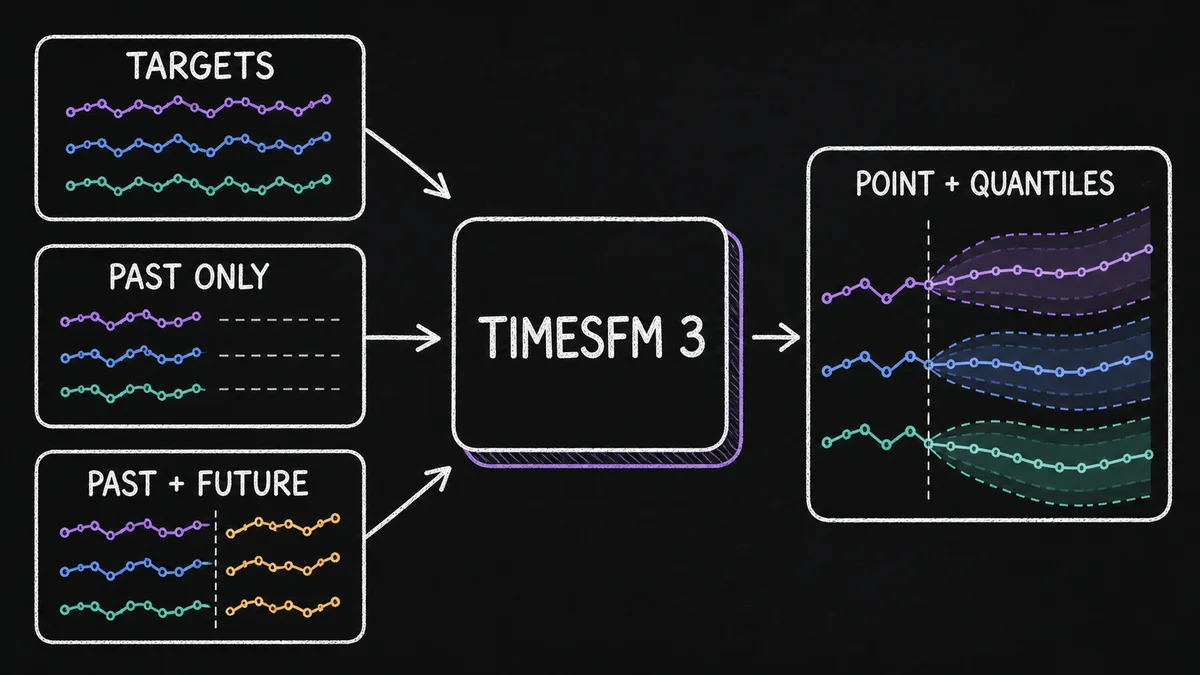
Our earlier TimesFM overview describes a family built around a decoder-only transformer and continuous patches. TimesFM 3 keeps that lineage, including patches of 32 time steps and per-series normalization, but changes what the model sees and how it decodes.
| Capability | TimesFM 2.5 | TimesFM 3 |
|---|---|---|
| Parameters | 200M | 330M |
| Pretraining scale | Large real and synthetic corpus | More than 1 trillion time points |
| Native targets | Univariate | One or many joint targets |
| Covariates | XReg integration | Native past-only and past-future covariates |
| Cross-series interaction | No native joint attention | Full variate attention at each time position |
| Horizon generation | Patch-by-patch | Full horizon in one forward pass |
| Uncertainty output | Optional continuous quantile head | Point forecast plus nine quantiles |
| Public weight license | Apache 2.0 | Non-commercial, non-production |
The change is deeper than accepting a two-dimensional array. TimesFM 3 is pretrained to distinguish three semantic roles:
- Targets are the series the model must forecast. Multiple related targets can be predicted jointly.
- Past-only covariates are observed over the context but unavailable in the future, such as realized foot traffic or a sensor that reports after the fact.
- Past-future covariates are known across both context and horizon, such as holidays, planned promotions, tariffs, schedules, or a weather forecast available at prediction time.
That input contract matches the way practitioners actually formulate many demand, load, capacity, and operations forecasts. It also turns the general advice in our guide to forecasting covariates into a native foundation-model interface rather than a separate regression layer.
#The Architecture: Time Across, Variables Down
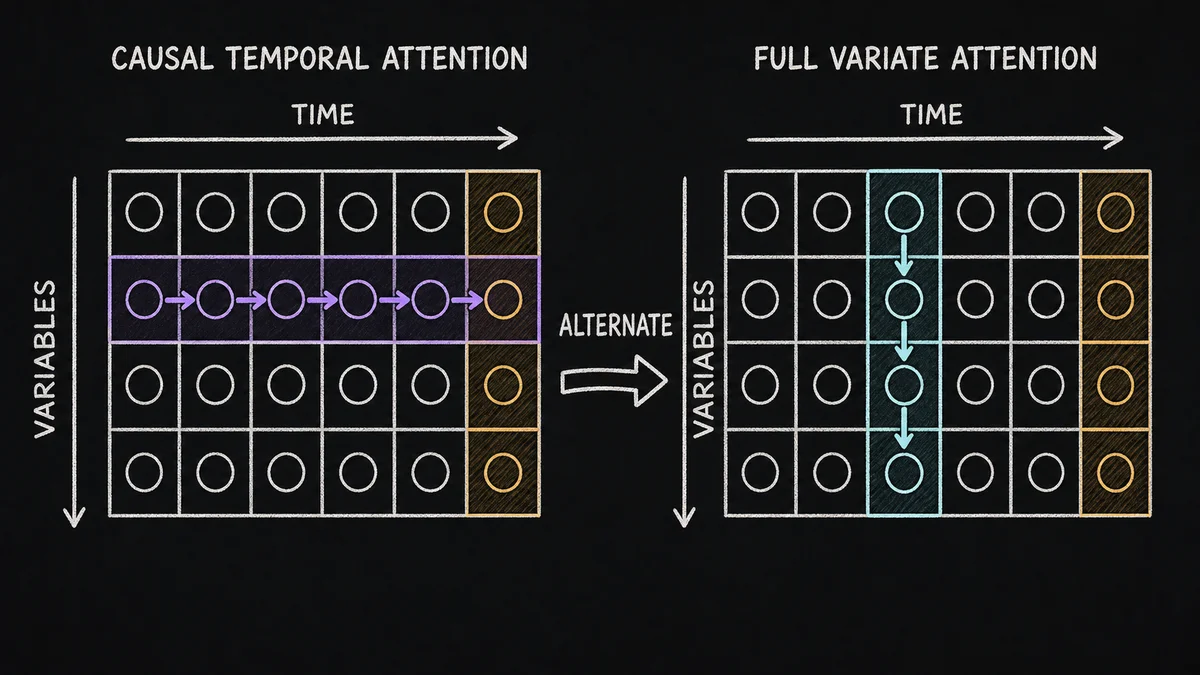
TimesFM 3 organizes tokens as a two-dimensional grid. Time runs along one axis; targets and covariates run along the other. The transformer alternates two kinds of attention through the stack.
Causal temporal attention moves horizontally within a single series. A token can use earlier patches from that series but cannot see later observations. This preserves the forecasting boundary.
Full variate attention moves vertically across series at the same time position. A target token can therefore incorporate information from related targets and covariates. This is where a promotion channel can inform sales, or an upstream pressure sensor can inform a downstream reading.
The separation is a sensible inductive bias. Temporal attention answers “what has this signal been doing?” while variate attention answers “what are the other signals telling us now?” Earlier multivariate models such as Moirai introduced similar cross-variate reasoning, but TimesFM 3 combines it with the TimesFM family's patched decoder and large-scale pretraining.
It also addresses an old paradox in multivariate forecasting: cross-channel modeling often underperforms channel-independent baselines when correlations are weak, unstable, or merely contemporaneous. Google evaluates TimesFM 3 in a univariate mode that suppresses cross-series information, and reports that it remains competitive or better than other reproducible TSFMs there. Multivariate mode then improves its aggregate rank where useful cross-series inputs exist.
That comparison is encouraging because a multivariate model should not need correlated inputs to be usable. But it does not eliminate the basic validation requirement: practitioners still need to compare joint forecasting against a channel-independent baseline on rolling, out-of-time splits. Full variate attention gives a model the ability to use every supplied relationship; it does not guarantee that every relationship will survive a regime change.
#Future-Known Signals Get a Lookahead Path
Future-known covariates require special handling. A normal causal token cannot inspect future patches without leaking target information. TimesFM 3 solves this by constructing past-future covariate tokens with a lookahead: the current patch is combined with future covariate patches that are legitimately available at forecast time.
The distinction between known in the future and observed only in the past is therefore structural, not just metadata. If next month's promotion plan is passed as a past-future covariate, the model can condition forecasts on promotion days. If realized store traffic is only available through today, it belongs in the past-only path and remains masked over the horizon.
This makes schema discipline important. Accidentally classifying a measured outcome as future-known would leak information directly into the forecast. Conversely, marking a genuine plan or calendar as past-only throws away some of the model's most valuable context. A production wrapper should validate that future-known columns come from a source that really existed at each historical forecast origin—not from a later, revised table.
#One Pass Instead of Autoregressive Rollout
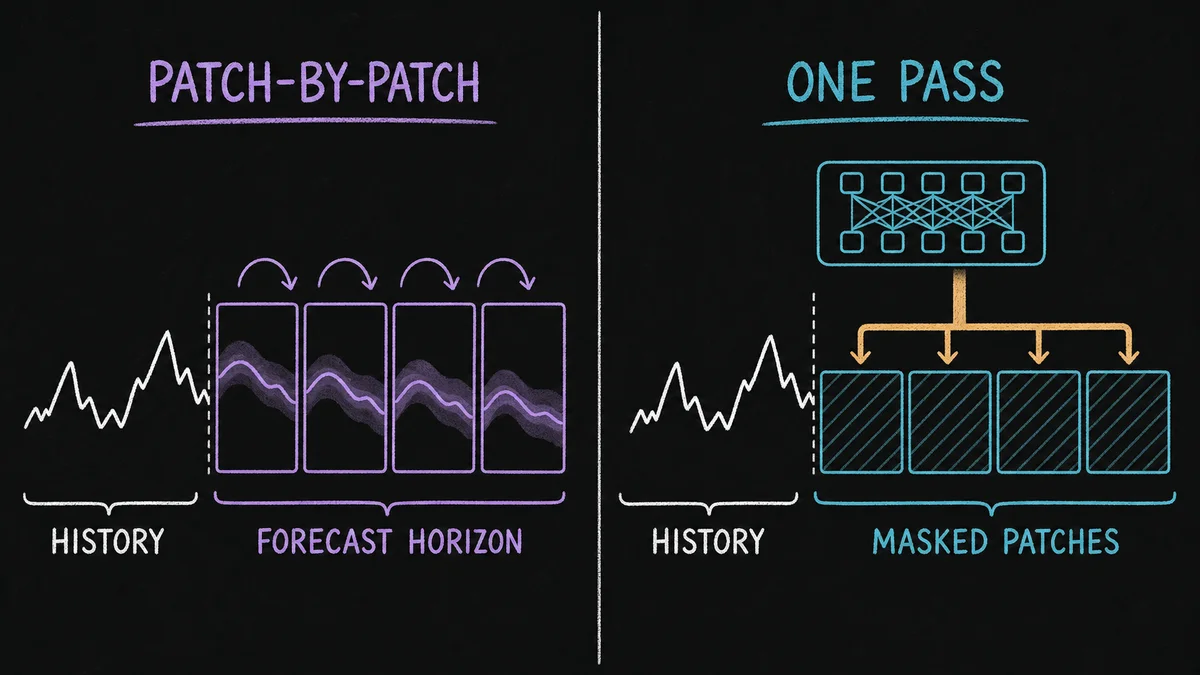
Previous TimesFM versions emitted one output patch and then continued decoding. That is more efficient than generating one scalar at a time, but long horizons still require repeated model steps, and early errors can become context for later predictions.
TimesFM 3 adopts Contiguous Patch Masking, a training strategy introduced with TiRex. Masked placeholder patches are appended for the entire future horizon. Targets and past-only covariates are hidden there, while future-known covariates remain visible. The transformer fills the target horizon simultaneously.
The immediate benefits are lower sequential latency and no patch-to-patch error propagation during decoding. The model also emits nine quantiles—from the 10th through the 90th percentile—for every target and horizon step, alongside the point forecast. That moves TimesFM from its historically point-first identity toward native probabilistic forecasting.
There is still a difference between producing quantiles and producing calibrated uncertainty. Teams should test empirical interval coverage by horizon, series group, and operating regime. Quantile crossing, undercoverage during shocks, and over-wide intervals in stable periods remain possible even when aggregate probabilistic scores are strong.
#Reading the Benchmark Claims Carefully
Google evaluates TimesFM 3 on three public suites: GIFT-Eval, FEV-Bench, and TIME. The launch charts report average model rank across tasks, with lower rank better. TimesFM 3 leads the compared pretrained models for both point and probabilistic metrics in full multivariate mode; its univariate mode also matches or exceeds the competing reproducible models in the reported aggregates.
The comparison set includes TimesFM 2.5, Chronos-2, and Toto 2.0 variants. That is meaningful: TimesFM 3 is not being compared only with the 2024 generation. It is entering a much stronger 2026 field that already includes native multivariate and covariate-aware systems such as TiRex-2.
Three details temper the result:
- Average rank hides effect size. A model can rank first by a narrow margin on many tasks or by a large margin on a few. The launch post does not publish the complete task-level score table needed to distinguish those cases.
- Multivariate uplift depends on benchmark inputs. Some datasets have strong cross-series structure or useful covariates; others do not. Aggregate rank does not tell a team how much lift to expect on its own schema.
- Pretraining overlap needs reproducible auditing. The model card says training uses GIFT-Eval pretraining data while excluding datasets that overlap FEV-Bench, plus Wikipedia pageviews, Google Trends, and synthetic or augmented data. That is useful disclosure, but release-day results should still be reproduced from the public checkpoint and benchmark code before they are treated as settled.
The right interpretation is “strong new default candidate,” not “universal winner.” Put TimesFM 3 into the same rolling backtest as a seasonal naïve baseline, a strong univariate TSFM, and another multivariate model. Report absolute errors and interval coverage, not only average rank.
#The License Is the Production Blocker
The TimesFM repository remains Apache 2.0 for source code, and checkpoints through TimesFM 2.5 retain their earlier licensing. The TimesFM 3 pretrained weights are different. Google distributes them under the timesfm-non-commercial-license-v1.0, which restricts them to non-commercial, non-production use.
That means the public checkpoint is suitable for research, evaluation, and internal model comparison only where the license permits. It is not currently a drop-in production model for a commercial forecasting service, demand-planning workflow, or customer-facing application. This distinction is easy to miss because the code repository itself is permissively licensed.
Google says a BigQuery integration is coming in the weeks after launch. That may provide a supported commercial path, but its availability, terms, features, and pricing should be evaluated when it actually lands. Until then, teams that need native multivariate forecasting in production should keep a deployable alternative in the benchmark—Chronos-2, TiRex-2, Moirai, or another model whose weights and serving terms fit the use case.
#A Practical Evaluation Plan
TimesFM 3 is most worth testing when at least one of these is true:
- multiple targets coevolve and must remain mutually coherent;
- future-known events materially change the forecast;
- historical-only sensors or business drivers contain lagged predictive information;
- long horizons make autoregressive latency or error accumulation costly;
- native quantiles are required for planning decisions.
Build the evaluation around the data contract rather than the model demo. At every historical forecast origin, recreate exactly what was known then. Separate target, past-only, and future-known columns. Compare univariate and multivariate modes to measure whether cross-series information adds real lift. Perturb or remove each covariate group to see which inputs the model relies on. Then score point error, quantile loss, empirical coverage, latency, memory, and sensitivity to missing channels.
Also test scale. Full attention across variables is attractive for tens of meaningful channels; it may become expensive or noisy when a dataset contains hundreds or thousands of loosely related series. Grouping variables by causal or operational relationship may be more robust than placing an entire warehouse table into one forecast request.
#What TimesFM 3 Changes
TimesFM 3 closes the largest capability gap in Google's forecasting family. The progression is now clear: the original model established large-scale zero-shot univariate forecasting; TimesFM 2.5 stretched context and improved efficiency; TimesFM 3 makes multiple targets, covariates, probabilistic output, and parallel horizon decoding part of one pretrained architecture.
The broader signal is that multivariate forecasting is becoming a first-class foundation-model task rather than a specialist extension. Model interfaces are converging around the actual ingredients of a production forecast: related targets, historical drivers, known plans, and uncertainty over the full horizon.
The release is technically ambitious and benchmark-competitive. For practitioners, the immediate move is to evaluate it, not deploy it: verify the gains on clean historical origins, inspect calibration and covariate dependence, and keep the non-commercial weight license in view. If Google follows with a supported commercial route and the public results reproduce, TimesFM 3 could reset the default baseline for multivariate forecasting. On launch day, it has earned that test—but not yet automatic trust.